
Melanoma
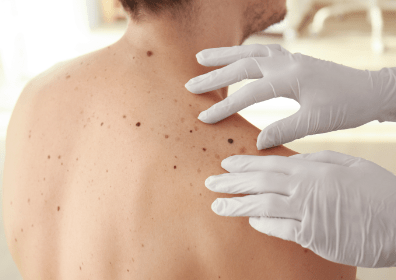
Melanoma is the most serious and dangerous form of skin cancer. It develops in the melanocyte cells of the skin, the cells responsible for producing melanin, the pigment that gives skin its colour. Although melanoma is the least common type of skin cancer, it tends to grow much faster than other types and carries a higher risk of spreading to other parts of the body.
Melanoma often shows up as a new spot on the skin, or as an existing spot that changes in size, shape or colour over a period of weeks to months. These spots typically have uneven edges, a flat or slightly raised surface, and may contain more than one colour.
Catching melanoma early greatly improves the outcome of treatment, and most cases are treated with a straightforward surgical excision.
Use the ABCDE method to check whether a mole could be a melanoma:
A – Asymmetry: one half of the mole looks different from the other half.
B – Border: the edges are irregular or poorly defined.
C – Colour: the mole shows several colours or shades that are changing.
D – Diameter: the mole is bigger than 6mm across.
E – Evolving: the mole has changed in size, shape or colour over time.
Basal Cell Carcinoma (BCC)
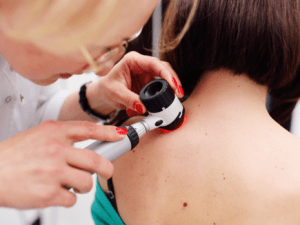
Basal cell carcinoma (BCC) is the most common form of non-melanoma skin cancer, arising in the basal cells found in the lower layer of the epidermis. BCCs typically grow slowly and rarely spread to other parts of the body, but if left untreated they can grow deeper into the skin, making treatment more complicated later on. People who have had one BCC are also more likely to develop further BCCs elsewhere on their skin over time.
BCCs most commonly appear on parts of the body with high sun exposure, such as the head, neck and upper body. They can look like a pearly or pale-red lump, or present as a scaly or shiny patch. As a BCC grows it may become inflamed, ulcerated or start to bleed, and can resemble a sore that never quite heals.
Squamous Cell Carcinoma (SCC)
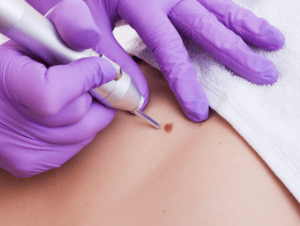
Squamous cell carcinoma (SCC) is another common type of non-melanoma skin cancer, developing in the squamous cells that make up the outer layer of the epidermis. Unlike BCCs, SCCs can grow quickly, sometimes over just a few weeks or months, and have a greater tendency to spread to other areas of the body when they become invasive. Because SCCs form near the skin’s surface, early detection generally means they can be treated effectively, often without the need for extensive surgery.
SCCs tend to develop on areas that get regular sun exposure, including the shoulders, hands, forearms and legs. They can present as a scaly, thickened or crusted patch of skin, sometimes pink or red in colour, or as a lump that grows rapidly. SCCs may bleed easily or feel tender when touched.
Non-Cancerous Skin Spots
Many spots that appear on the skin are harmless, but some benign lesions can still develop into skin cancer over time, which is why it’s worth keeping an eye on any changes.
Moles, or naevi, are a common and normal skin feature that form when melanocyte cells cluster together. The tendency to develop many moles can run in families, and childhood sun exposure can also increase how many moles a person ends up with. People with a large number of moles face a somewhat higher risk of skin cancer, including melanoma.
Sunspots, also called actinic or solar keratoses, build up gradually over many years and are most often seen in people over 40. They’re a sign of significant cumulative sun exposure and are linked to a higher chance of developing skin cancer.